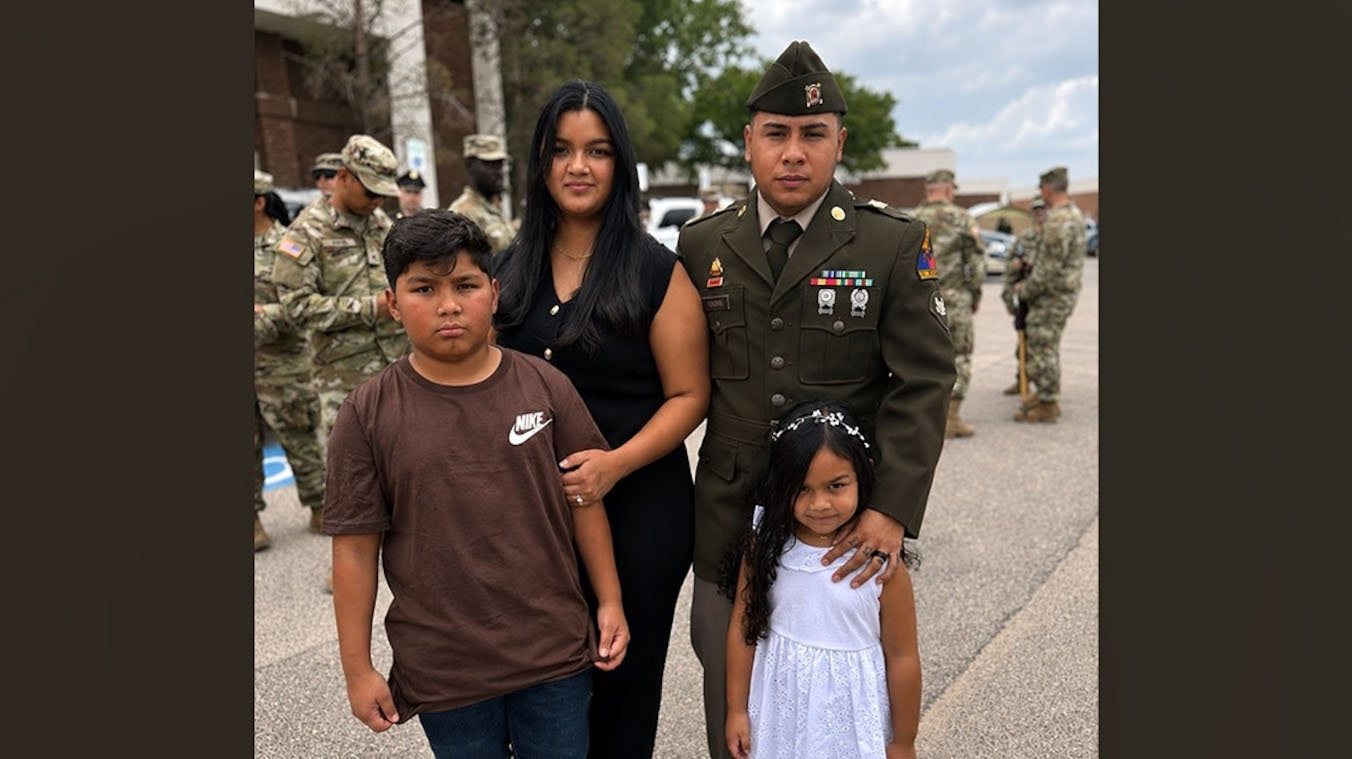
(WASHINGTON) -- Army Sgt. Hedar Leonel Turcios Juarez woke up to a gut-wrenching call at 3:40 a.m. Tuesday: Cristy Maryori Villafranca Trejo, his wife and the mother to their 6-year-old daughter, was aboard a plane about to be deported to Honduras.
Turcios told ABC News that he scrambled to stop it. He stayed on the phone with an Immigration and Customs Enforcement (ICE) officer, sending documentation showing that his wife's immigration case was still pending. After the officer confirmed the paperwork, Villafranca was pulled from the flight and returned to Camp East Montana, the detention center at Fort Bliss, Texas, where she remains.
It was the latest turn in an ordeal that began July 11, when masked ICE officers detained Villafranca outside a Walmart as the couple's young daughter watched. Villafranca left Honduras in 2016 due to violent crime in the country, her husband said.
"My wife is everything to me, to my family, for my daughter, and it's just sad that we are still being treated like criminals, just because we weren't born in this country," said Turcios, who became a U.S. citizen in 2024 after joining the military.
The U.S. Department of Homeland Security, which oversees ICE, did not reply to an ABC News request for comment about Villafranca's case.
Turcios' family is hardly alone. President Donald Trump's mass deportation campaign has swept up more than 50 parents and spouses of service members during his second term, with at least six deported, according to an investigation by the Associated Press.
Danitza James, CEO of Repatriate Our Patriots, which works with Families United to help active-duty service members and veterans reunite their families, said that, beyond providing legal representation, the organization's only other strategy has been to call Congress to request help.
She said she is currently working with eight active-duty service members and one veteran whose family members have been detained as of Aug. 20. ABC News spoke with two of the families that she is working to unite.
The cases complicate one of the administration's central arguments for its aggressive expansion of immigration enforcement. Trump has repeatedly said ICE is targeting the "worst of the worst," and has described immigrants who entered the U.S. illegally as "animals" and "dangerous criminals" that should not be in the country.
An ABC News review of state and federal records did not find criminal records for any of the military spouses named in this story in the states where they live.
"She's been a very supportive wife since the first day that I decided to join the military. I was deployed for nine months. She took care of my family," Turcios said of his spouse. "She's not a threat to anybody. We're just trying to keep our family together."
The Trump administration's detention of undocumented spouses and parents of active-duty service members comes as the U.S. is at war with Iran, leaving troops without the support of their families and shifting their focus away from their military careers, advocacy groups say. Some have been forced to take leave from duty to care for their children in their spouses' absence, according to advocacy groups and families ABC News interviewed.
"There are so many military families of active-duty service members that are living in the shadows of this immigration machine, that is putting them in fear of seeking resources and asking for help, while their service member is actively serving our country, and sacrificing for our nation," said James of Repatriate Our Patriots.
Military service has long been a pathway to citizenship
For decades, military families have occupied a protected corner of the immigration system, according to the National Military Family Association. Under policies embraced by Republican and Democratic administrations, the undocumented parents and spouses of service members have generally been shielded from deportation.
Military recruiters have also long promoted military service as a pathway to citizenship, including through programs which can allow undocumented relatives of troops to remain in the country while applying for a green card and work authorization.
The bargain extends to troops themselves. Green card holders can join the U.S. military and troops can apply for naturalization after a year of honorable service, an incentive that stretches back to the Civil War. During World War I, Congress went further, streamlining the citizenship process for troops whose enlistment could effectively mean automatic citizenship.
“Having a family member in the military is not a free pass to violate our nation’s laws," a DHS spokesperson said in response to the recent arrest by ICE of the father of an active-duty sailor for alleged immigration violations. "Military service by an immediate relative does not automatically grant parole, lawful status, or immunity from immigration enforcement."
Racial and ethnic minorities are making up a growing share of the military. In the Army, the Pentagon's largest service by far, Hispanic recruits grew from about 19% of new enlistees in 2020 to nearly 27% last year, according to internal service data reviewed by ABC News.
Naturalizations through military service have also more than tripled over roughly the same period, rising from about 4,500 in 2020 to 16,000 in 2024, according to Department of Homeland Security data. The Philippines, Mexico, Jamaica and Nigeria were among the leading countries of origin for troops who became U.S. citizens through their service.
Turcios left Honduras in 2014, also to escape violence in the country, he said. After attending high school in the U.S. he joined the military and became a U.S. citizen in 2024 after a nine-month deployment to the Middle East. Then he began pursuing citizenship for his wife, hoping his service would help expedite her naturalization process, he said.
Instead, Villafranca, undocumented spouses and parents of many other active-duty military personnel have been forced into detention, according to lawyers, advocacy groups and military families.
Villafranca relayed allegedly inhumane conditions in Camp East Montana, according to her husband. The facility is the country's largest detention center, which sits on land formerly used for Japanese-American internment camps during World War II.
Turcios said his wife had to wear the same clothes for about four days. Access to clean clothing remained an issue until he reached out to Rep. Veronica Escobar, D- Texas, who sent an inquiry to ICE regarding Villafranca's lack of clean clothing. Turcios said that after a few weeks, they finally fixed the issue.
Detained at green card interview
Army Staff Sgt. Alexis Jaramillo has served in the military for 11 years and is currently stationed at Fort Polk, Louisiana. His wife, Maisa Lopes Eliaser, came to the U.S. from São Paulo, Brazil, in 2019 on a tourist visa, which she had overstayed while Jaramillo was helping her pursue citizenship.
She was taken into custody in front of Jaramillo, who was dressed in uniform, and their five-year-old son during an appointment to be interviewed to get her green card.
Lopes Eliaser spent two days in Pickens County Jail in Georgia before being transferred to the South Louisiana ICE Processing Center, where she slept in a large room with approximately 80 people for about six weeks, her husband said.
On July 13, Lopes Eliaser said ICE officers put her on a bus to the Alexandria International Airport in Louisiana. She was then flown to Bogotá, Colombia, where the plane stopped before its final destination, Brazil. During the layover, Lopes Eliaser called her husband using someone else's phone, he said.
Jaramillo said he had been communicating with Sen. Mark Kelly, a Navy veteran, about his wife's case before she was taken to the airport. When Lopes Eliaser disappeared from the detainee-tracking app that Jaramillo was checking, he contacted Kelly again to ask for help bringing her home.
"Maisa's case is an example of this administration's focus on targeting the loved ones of those who've stepped up to serve our country. It's wrong and makes no sense at all," Kelly wrote in a statement to ABC News.
Kelly's office told ABC News that his casework team established communications with the ICE field office and kept Jaramillo updated.
DHS did not respond to a request for comment on Eliaser's case at the time.
What members of Congress are doing
Jaramillo credits Kelly for contacting ICE and getting Lopes Eliaser eventually returned to the U.S. When she landed in Brazil, she was flown back to the Alexandria International Airport without ever stepping off the airplane. Jaramillo and Lopes Eliaser were reunited and are currently together at their home in Louisiana.
"That was a nightmare. That was a really, really nightmare," Jaramillo said. "I'm never going to explain best how difficult it was and still is."
While Jaramillo and Lopes Eliaser are now united, they are still dealing with the aftermath of her detention and deportation. Jaramillo had to take leave to care for his son and fight to get his wife back. Now that his wife is back home, he said he will return to service on Monday.
Since Lopes Eliaser was first detained, Jaramillo said he has incurred more than $7,000 in legal fees and costs associated with submitting paperwork, approximately equal to over a month's pay.
Jaramillo said his wife is still experiencing health issues from the conditions of detention, which he said were crowded and where she also lacked access to clean clothing. Jarmillo said he took her to see a doctor Thursday.
James said that many of the other cases of active-duty military service members' families being detained have involved members of Congress making calls to reunite families.
Kelly has publicly been involved with two other cases of military families targeted by the Trump administration for deportation.
In a letter sent Aug. 9 to DHS, the Defense Department and the Department of Veterans Affairs, congressional Democrats wrote that they will investigate whether the Pentagon and DHS are coordinating to deport military service members and their families.
"The best way to bring change to this is to the legislative or policy, because this should not be a phone call. This should not be a one-case change," James said. "This is clearly impacting more than 50 military spouses and cases across the board, and there needs to be a change that is codified."
Copyright © 2026, ABC Audio. All rights reserved.